
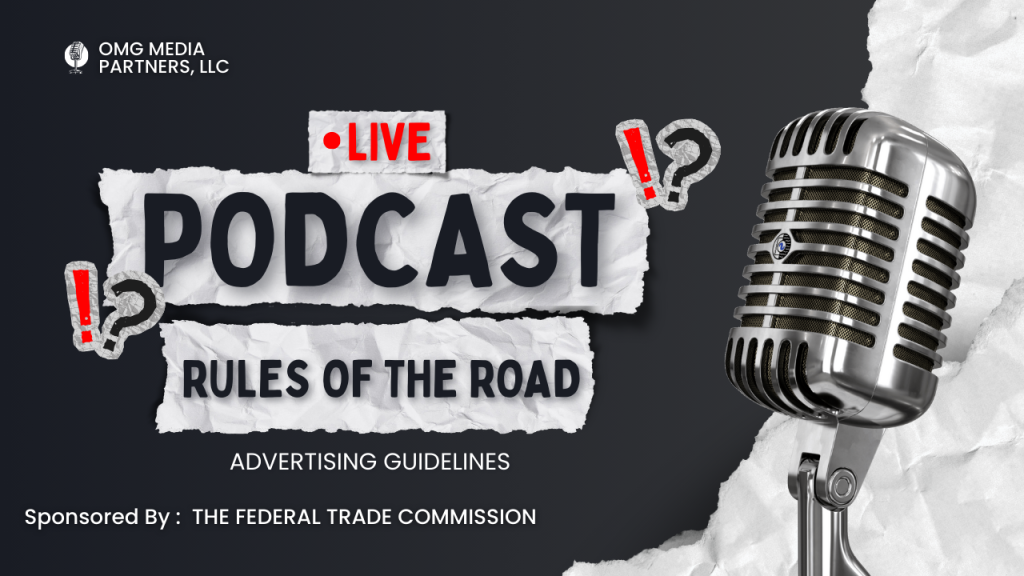
For most of podcasting’s short history, advertising lived comfortably in ambiguity. Hosts spoke conversationally about products they liked. Affiliate links appeared quietly in show notes. Sponsorships blended into commentary, indistinguishable from opinion or storytelling. The system relied on trust—between host and listener, creator and platform, brand and audience.
That trust is now being tested, and in many cases, revoked.
From the Federal Trade Commission’s perspective, there has never been a gray area. Podcasts are advertising media. If a creator receives money, free products, affiliate commissions, discounts, equity, or any other material benefit in exchange for promoting a product or service, disclosure is legally required. It must be clear, conspicuous, and unavoidable. Not implied. Not buried. Not assumed.
What has changed is not the rulebook. It is enforcement—and tolerance.
In recent months, compliance firms and media agencies have fielded a steady stream of quiet calls from creators who were “caught off guard.” In one case, a mid-sized podcast lost its primary sponsor after a routine legal audit uncovered years of undisclosed affiliate promotions. The sponsor exited immediately, citing regulatory exposure. There was no negotiation.
In another, a podcast that repurposed episodes for YouTube woke up to a terminated channel. No strike history. No warning. No meaningful appeal. The reason given was “undisclosed paid promotion.” Years of content and revenue vanished overnight.
This is increasingly how enforcement happens—not loudly, not publicly, and not gradually.
Nowhere is this shift more unforgiving than on YouTube.
YouTube has become the primary growth and monetization engine for many podcasts, but it is also the least tolerant of ambiguity. Creators are required to disclose paid promotions in two ways: by using YouTube’s built-in paid promotion declaration tools, and by clearly informing viewers within the video itself when appropriate. These requirements apply not only to traditional sponsorships, but to affiliate links, product placements, gifted items, and revenue-sharing arrangements.
What many creators misunderstand is that YouTube does not treat non-disclosure as a minor policy error. It treats it as deception.
Enforcement is frequently automated. Context rarely matters. Prior good standing offers little protection. Channels can be demonetized, restricted, or terminated without notice, and appeals—when acknowledged at all—often arrive too late to salvage a business built on consistency and momentum.
We have seen creators assume that a disclosure in audio alone is sufficient. It is not. Others believe that a casual line in the description—“links below” or “thanks to our partners”—is adequate. It is not. Some rely on affiliate network boilerplate placed far below the fold. It is not.
YouTube expects disclosures to be obvious, proximate, and unambiguous.
A compliant description disclosure should look something like this:
Disclosure: This video contains paid promotion. The links below are affiliate links, meaning we may earn a commission if you make a purchase at no additional cost to you.
Or, for a direct sponsorship:
Sponsored Content: This episode is sponsored by [Brand]. We were paid to feature this product.
Or, when products are provided for free:
Disclosure: [Brand] provided this product at no cost for review. No other compensation was received.
These disclosures should appear near the top of the description, not buried beneath timestamps, credits, or unrelated links. If multiple products are promoted, that should be clear. If affiliate links are used, that should be stated plainly. Ambiguity is interpreted against the creator.
Just as importantly, the description disclosure does not replace the need for an on-video acknowledgment when the promotion is integrated into the content itself. YouTube expects viewers to understand, in real time, when they are watching advertising.
Creators often assume enforcement will be incremental—a warning email, a strike, a chance to correct. Increasingly, it is not. The platform’s priority is protecting users and advertisers, not preserving creator revenue. Once a channel is flagged as deceptive, the burden shifts entirely to the creator, often with no clear path back.
This is not an abstract risk. It is already reshaping the industry.
Brands are adjusting accordingly. Advertising contracts now routinely require creators to indemnify sponsors against disclosure failures. Agencies are auditing back catalogs. Some are quietly declining to work with shows whose compliance practices are unclear. The cost of non-disclosure is no longer hypothetical; it is operational.
At OMG Media Partners, LLC, we increasingly see these failures not as bad faith, but as blind spots—habits formed in a less regulated era that no longer exists. Creators who built audiences on authenticity are discovering that authenticity without transparency is no longer enough.
The reckoning will not arrive as a single dramatic crackdown. It will arrive in fragments: a demonetized channel here, a sponsor withdrawal there, a show that quietly goes dark after revenue evaporates. By the time the pattern becomes obvious, it will already be too late for many.
Disclosure is not bureaucracy. It is infrastructure. It is the price of durability in an ecosystem that has decided, finally, to grow up.
Creators who want to last will adapt. They will disclose early, plainly, and consistently—on air, on screen, and in writing. They will treat compliance as part of production, not an afterthought.
Because in today’s podcast economy, the fastest way to lose your platform isn’t saying the wrong thing.
It’s failing to say when you’re being paid.
Navigating these rules may feel overwhelming, especially for creators who are focused on content, audience growth, and monetization. That’s where expertise matters. At OMG Media Partners, LLC, we help podcasters and digital creators implement clear, compliant disclosure practices across all platforms—audio, video, and written. From structuring sponsorship announcements to formatting affiliate links and drafting on-screen or in-description disclosures, we ensure your show meets FTC and platform requirements while maintaining audience trust.
Compliance doesn’t have to slow down your creativity—it can safeguard it. With the right systems in place, you can continue building your audience and monetizing your content, confident that you’re operating within the rules and protecting your most valuable asset: your credibility.