
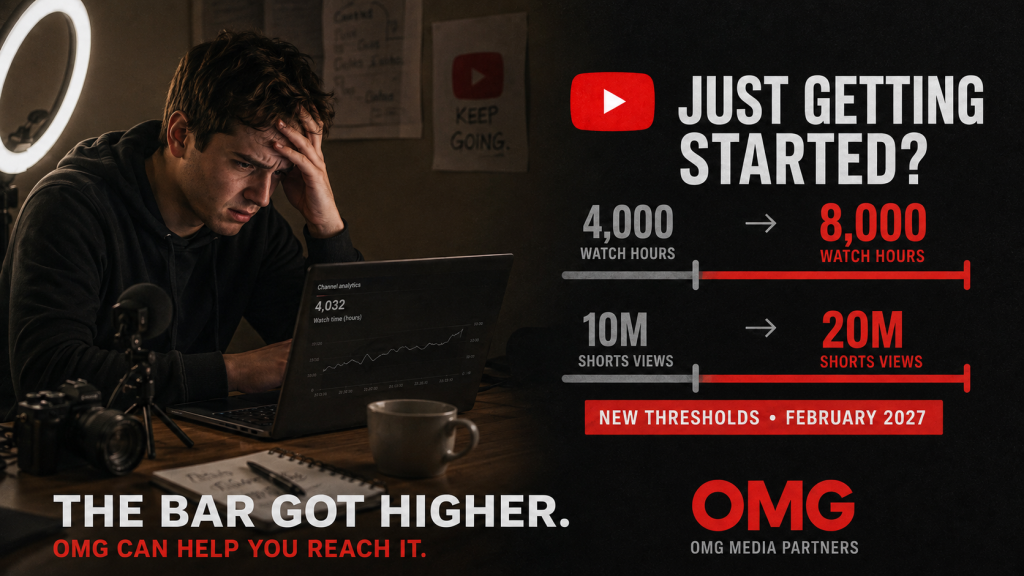
YouTube is about to make it much harder for new creators to earn money from advertising.
Beginning February 1, 2027, channels applying for ad and YouTube Premium revenue sharing will need either 8,000 qualified public watch hours during the previous 365 days or 20 million qualified public Shorts views within 90 days. Both figures are double the current requirements of 4,000 watch hours or 10 million Shorts views.
For anyone already in the YouTube Partner Program, there is no need to panic. YouTube says existing YPP members will not lose their status because of the higher entry requirements. The lower thresholds that provide access to fan-funding and Shopping features are also staying in place.
But for creators who are still working toward full monetization, this is a major change. The finish line is being moved considerably farther away.
YouTube’s explanation is that the platform has grown. That is certainly true. According to the company, Shorts now generate more than 200 billion views every day, while viewers watch more than one billion hours of YouTube content on television screens daily. YouTube is no longer simply competing with other social platforms. It is competing with traditional television, streaming services, podcasts and nearly every other form of entertainment.
That growth has created enormous opportunities for creators, but it has also created a much more crowded marketplace. More channels are publishing more content than ever before, all competing for the same limited supply of attention. YouTube appears to be signaling that earning a share of its advertising business will now require a creator to demonstrate a more substantial and sustained audience.
The numbers are more demanding than they may initially sound. Eight thousand watch hours equals 480,000 minutes of viewing. If the average viewer watches five minutes of a channel’s videos, that channel would need approximately 96,000 qualifying long-form views within a year just to reach the watch-hour requirement.
The Shorts route is steeper still. Reaching 20 million views in 90 days requires an average of more than 222,000 qualified views every day. A creator might catch lightning with a viral Short, but building a business around the expectation of repeated viral success is not much of a business plan.
The new rules do not mean aspiring creators should abandon YouTube. They do mean that the casual approach—posting whenever inspiration strikes, jumping from topic to topic and hoping the algorithm eventually notices—is becoming less viable.
Creators who are already approaching the current monetization threshold should treat the months before February as a real opportunity. This is the time to examine which videos are producing the most watch time, determine why viewers are responding to them and create more content around those same interests. A channel that is close to qualifying should not waste that momentum.
It is also a reminder that views alone do not build a successful channel. A title and thumbnail may earn the click, but the video must keep the viewer’s attention. Long introductions, slow openings and unnecessary detours become expensive when watch time is the goal. The strongest channels establish the value of a video quickly and then deliver on the promise that brought the viewer there.
Individual videos also need to work together. One good interview, commentary video or documentary should naturally lead the audience to another. Recurring formats, related episodes, follow-up videos and well-organized playlists can turn a single view into a longer viewing session. Over time, a connected library of content is far more valuable than a collection of unrelated uploads.
Shorts will remain an important discovery tool, but the new 20 million-view requirement makes it risky to view short-form content as the only path to monetization. A better strategy is to use Shorts to introduce new viewers to a creator’s work and then give those viewers a reason to watch longer videos, join a livestream, subscribe to a newsletter or become part of a community.
Perhaps the most important lesson is that YouTube ad revenue should never be the entire business. Sponsorships, memberships, affiliate partnerships, merchandise, premium content and direct audience support can all generate revenue before a channel qualifies for full advertising benefits. In many cases, those sources can eventually become more valuable than the ads themselves.
YouTube is not closing the door on new creators, but it is making that door harder to open. The platform increasingly favors channels that can produce sustained attention through consistent programming, clear positioning and professional execution. Simply uploading more videos will not be enough. The content needs to be packaged well, distributed intelligently and created for a clearly defined audience.
For creators with momentum, the response should be urgency. For those starting from scratch, the response should be strategy.
At OMG Media Partners, we help creators, experts and independent media brands turn ideas into professionally produced, consistently distributed and revenue-ready channels. YouTube is changing. The people who build for where the platform is going—not where it used to be—will have the best chance of succeeding.
Sources: YouTube’s official YPP announcement and YouTube Help’s monetization overview.